Choosing a South Indian granite by colour alone can create problems: a black stone may show scratches, a polished floor may become slippery when wet, and slabs carrying the same trade name may vary from one block to the next. By the end, you will be able to identify the main regional varieties, match granite properties and finishes to each application, and approve slabs with fewer surprises on site.
Key takeaways
- South Indian granite includes granite and related rocks from five major states.
- Match stone characteristics to the project’s traffic, moisture, exposure, and design demands.
- Use honed or flamed finishes where polished surfaces create slip or glare risks.
- Approve slabs only after checking test reports, dimensions, variation, and visual continuity.
What qualifies as South Indian granite, and how do the main varieties differ?
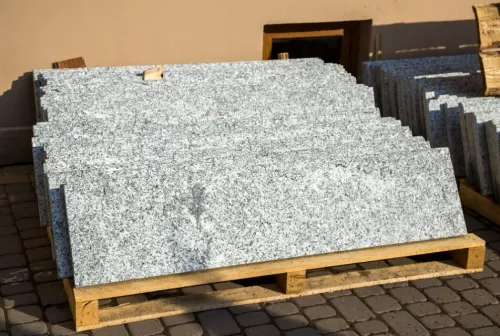
South India granite is a trade-geographic category, not one uniform stone. It covers commercial material quarried in Tamil Nadu, Karnataka, Andhra Pradesh, Telangana and Kerala, including true granite and related rocks such as gabbro, charnockite and anorthosite. The quarry and block determine mineral composition, durability and variation—not the colour name alone.
| Variety | Recognisable appearance | Slab-to-slab variation |
|---|---|---|
| Absolute Black | Deep, mostly consistent black surface | Veining, grey patches and small mineral marks can vary by block |
| Black Galaxy | Black ground with bronze-gold to copper-coloured flecks | Fleck size, density and direction can change noticeably; quarried around Ongole in Andhra Pradesh |
| Steel Grey | Medium-to-dark grey background with black and silver minerals | Grain scale and tonal balance can shift between slabs |
| Tan Brown | Brown ground with black minerals and burgundy accents | Brown intensity and crystal distribution are not always uniform |
| Colonial White | Cream or pale grey background with darker grey movement | Vein density and background warmth can differ |
| Kashmir White | Light grey-to-white field with dark inclusions and occasional burgundy or red garnet-like patches | Reddish material and dark mineral concentration can change substantially |
| River White | White or pale grey background with flowing grey movement | Vein direction, contrast and patchiness vary across a bundle |
Tamil Nadu granite and Karnataka granite therefore cannot be treated as interchangeable categories. Approve premium work by inspecting the actual blocks or slabs, because a small sample can hide the variation that dominates a large installation.
Which granite characteristics suit each premium project application?
The same slab can suit one premium setting and fail in another. Match each use to water absorption, stain resistance, abrasion, flexural strength, slip performance, finish, thickness, and colour variation.
| Application | Characteristics to prioritise | Main risk to control |
|---|---|---|
| Kitchen worktops | Low absorption, stain resistance, polished or leathered finish, reliable edge strength | Etching, staining, and chips around sinks and cut-outs |
| Flooring | High abrasion resistance, even thickness, low-to-moderate absorption, honed or textured finish | Polished surfaces become slippery when wet |
| Staircases | High flexural strength, durable nosing, consistent thickness, slip-conscious finish | Cracked treads or unsafe polished edges |
| Façades | Low absorption, strong flexural performance, freeze-thaw resistance where relevant, secure anchoring | Water ingress, panel movement, and fixing failure |
| Exterior paving | Abrasion resistance, low absorption, flamed or other tested textured finish | Roughness traps dirt; smooth stone loses traction |
| Bathroom vanities | Low absorption, stain resistance, sealed cut-outs, easy-clean finish | Standing water enters joints or tap holes |
| Wall cladding | Slab stability, colour continuity, suitable thickness, polished or honed finish | Lot changes create visible shade breaks |
| Fireplaces | Heat tolerance, low porosity, sound slabs, stain-resistant finish | Thermal shock and soot expose fissures |
| Reception desks | Polished colour depth, stain resistance, abrasion resistance, large slab size | Seams and repairs show under direct lighting |
| Hotel lobbies | Heavy-wear resistance, slip-tested finish, consistent lot, easy maintenance | Traffic creates wear patterns and glare |
| Monuments | Low absorption, weathering resistance, flexural strength, colour stability | Moisture, pollution, and carving defects shorten service life |
Approve the finished surface, not only the polished sample. Reserve slabs from one quarry lot, record orientation, and inspect a full-size mock-up wet and dry; these steps protect visual continuity across granite applications, including granite kitchen worktops, granite flooring, and granite staircases.
Which granite finish works best indoors, outdoors, and in wet areas?
Choose polished granite for low-maintenance indoor surfaces, but choose a textured finish for floors, exterior paving, and wet zones where glare and slip risk matter more than maximum colour depth.
| Finish | Colour and texture | Maintenance, glare and slip performance |
|---|---|---|
| Polished granite | Deepest colour, sharpest pattern, glossy and smooth | Easy to wipe clean; reflects light strongly and can become slippery when wet. Best for worktops, desks and wall panels. |
| Honed granite | Softer colour with a matte, smooth surface | Reduces glare and floor slipperiness compared with polish, but can show oil, water marks and stains more readily. |
| Leathered granite | Preserves colour with a lightly raised, tactile texture | Hides fingerprints and minor marks; cleanability varies with texture. Useful for vanities, counters and sheltered floors. |
| Flamed granite | Paler, less saturated colour with rough, uniform mineral texture | Strong exterior choice for paving and steps; improves wet traction, but its pores and texture collect dirt. |
| Brushed granite | A directional, weathered texture with muted sheen | Provides visual depth and some grip; requires attentive cleaning where grooves retain grime. |
| Sandblasted granite | Evenly rough, low-glare surface | Suits wet paving and high-slip-risk areas, but is harder to clean and can wear unevenly. |
Approve the actual finished sample, not just the slab. Test it wet and dry with the proposed grout joints, then confirm finish-specific slip results, absorption, abrasion resistance and cleaning response before installation. Sealing slows staining; it does not make a glossy floor safe or a rough surface maintenance-free.
How should premium slabs be selected for colour, grain, and visual continuity?
Select premium slabs as a coordinated set, not as isolated samples. Granite colour variation, grain movement, and replacement risk become obvious when slabs are viewed together under the project’s actual lighting.
1. Reserve slabs from the same quarry lot or block, and record the intended sequence. Compare full-size slab photographs or arrange a dry layout before cutting; the same trade name does not guarantee a matching background.
2. Decide the grain direction before fabrication. For bookmatched granite, open adjacent slabs along the matching cut so the veining mirrors across the joint. Use one orientation consistently on long counters, stair treads, or wall panels instead of rotating slabs casually.
3. Inspect the background first, then the pattern. Reject a set with abrupt changes in base colour, unusually dense mineral clusters, or veining that conflicts with the design. Natural granite fissures are acceptable only when stable, disclosed, and suitable for the application; do not confuse them with open cracks.
4. Mark resin-filled pits and repairs on the approval sheet. Hold each slab upright and inspect both faces for filled cavities, colour patches, scratches, and polished-over damage; repairs that disappear from a distance can show at an edge or under raking light.
5. Confirm nominal thickness, calibrated thickness, flatness, slab length, width, and usable area. Check that the size covers the planned pieces with safe margins, and specify thicker stone or concealed support for large overhangs and unsupported spans.
6. Inspect cut edges and corners for chips, resin, warping, and repaired breaks. Approve the exact finish on a sample or mock-up, then compare the slabs wet and dry under the project lighting; moisture can deepen colour and expose uneven polishing.
What technical checks should be completed before granite is approved?
Approve a named quarry lot, not merely a commercial name. Request current test reports for the actual material, then compare them with the demands of the intended application.
1. Verify granite water absorption and bulk specific gravity under ASTM C97/C97M. Low absorption supports stain and moisture resistance, but does not prove structural strength.
2. Verify granite flexural strength under ASTM C880/C880M. Use the result with panel dimensions, anchors, wind loads, seismic movement, and edge distances for façade design; never transfer a countertop specification to cladding.
3. Check abrasion resistance using a stated test method and compare it with traffic levels. A lobby floor and a lightly used wall do not need the same wear performance.
4. Test the selected finish for slip performance in wet and dry conditions. Review polished, honed, flamed, or textured finishes in a mock-up, because finish and grout detailing change the result.
5. Measure every approved slab for thickness and flatness. Reject pieces outside the project tolerance if unevenness will telegraph through cladding, disrupt joints, or complicate installation.
6. Record quarry, block, lot, slab numbers, finish, thickness, and grain direction. Approve a dry layout or full-size slab photographs before replacement material enters the order.
Jaishree Stones can help coordinate full-size samples, report collection, and project-specific review with the architect, fabricator, and installer. Approve the mock-up under actual lighting and, for floors or paving, inspect it after wetting and cleaning.
Frequently asked questions
What qualifies as South Indian granite?
It is a trade-geographic category covering commercial stone quarried in Tamil Nadu, Karnataka, Andhra Pradesh, Telangana, and Kerala. The category includes true granite and related rocks such as gabbro, charnockite, and anorthosite.
Which granite characteristics matter for premium projects?
Match mineral composition, durability, colour variation, grain, water exposure, traffic, and maintenance demands to the application rather than choosing by colour name alone.
Which granite finish works best indoors, outdoors, and in wet areas?
Polished finishes suit areas where reflectivity and easy cleaning are priorities. Honed finishes reduce glare indoors, while flamed or textured finishes provide greater traction outdoors and in wet areas.
What should you check before approving granite slabs?
Check the quarry or block identity, technical test reports, slab dimensions, thickness, surface defects, colour and grain consistency, and whether the approved slabs provide visual continuity across the installation.